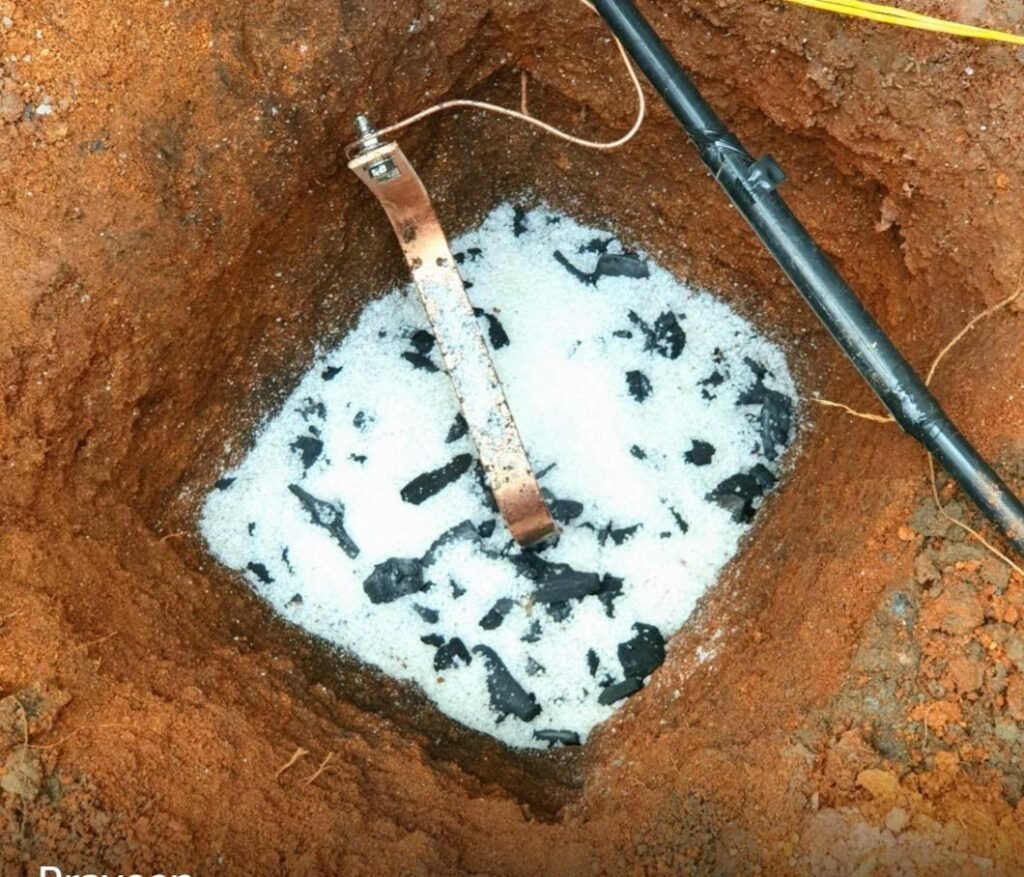
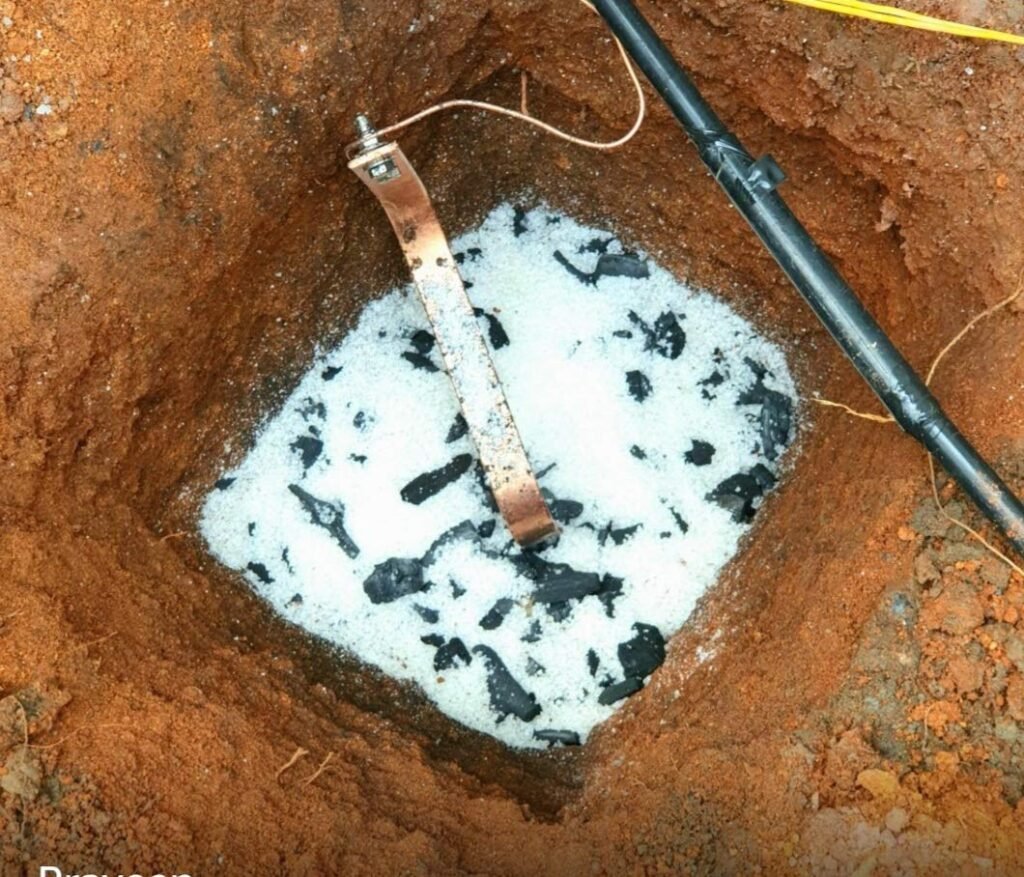
- The resistance offered by the earth electrode to the flow of current into the ground is known as the earth resistance or resistance to earth.
- Ideally a ground resistance should be of zero ohms but It is always greater than Zero .System ground resistances can be reduce by the use of a number of individual electrodes connected together.
- Total earthing resistance is the sum of the resistance of earth lead wires, Contact resistance between the surface of the earth electrode and the soil and The resistance of the body of the soil surrounding the earth electrode.
- The value of earthing resistance varies on the Type of Soil, Soil characteristic, soil resistivity and the climatic condition. Moisture content in soil plays a vital role in the soil resistivity. value of individual earthing pit resistance is not so important. Different codes specifies the required value of earthing system.
- Electrical Systems can work with earth resistance of 20 ohms, though generally 10 ohms is the specified Maximum limit.
- But communication systems need very stringent limit, typically one ohm. This is because the higher the ground resistance, higher would be noise interference in the systems.
| USAID | |
| a) Power stations (generating station) | 0.5 ohms |
| b) EHT Sub-station | 1.0 ohms |
| c) 33 KV Stations | 2.0 ohms |
| d) D/t Structure | 5.0 ohms |
| e) Tower Foot resistance | 10.0 ohms |
| IEEE STANDARD 142 | |
| Chapter: 4.1.3 , page 164 | |
| For industrial plant substations and buildings and large commercial installations. | 1Ω to 5 Ω |
| Resistances of less than 1 ohm may be obtained using a number of individual electrodes connected together. Such a low resistance is only required for large substations, transmission lines, or generating stations. | |
| National Electric code (NEC) 2011, (IS SP30 Chapter 14 -India) | |
| Chapter: 3.0.9 | |
| unless otherwise specified ,It is recommended that the value of any earth system resistance shall not be more than | 5Ω |
| IS 3043 (India) | |
| Chapter: 22.2.3 | |
| The continuity resistance of the earth return path through the earth grid should be maintained as low as possible and in no case greater than | 1Ω |
| This applicable for main earth grid connected with the transformer/return path | |
| Oil Industry Safety Directorate Government of India (OISD STANDARD – 137) | |
| Chapter: (7. ii. b) Allowable earth-Resistance Values | |
| Allowable earth-Resistance Values The resistance value of an earthing system to general mass of the earth should not exceed. | |
| For electrical systems and metallic structures. | 4Ω |
| For storage tanks. | 7Ω |
| for main earth grid, and bonding connections between joints in pipelines and associated facilities. | 1Ω |
| for each electrode to the general mass of the earth | 2Ω |
| IS 2309 (india) / BS 7430:1998 | |
| Clause:12.3.1 Page 32,Resistance to Earth | |
| Lightning arrestors ground resistance for Protection of buildings and allied structures is | 10Ω |
| An earth electrode should be connected to each down conductor. Each of these earths should have a resistance not exceeding the product given by 10 a multiplied by the number of earth electrodes to be provided. | |
| The whole of the lightning protective system, including any ring earth, should have a combined resistance to earth not exceeding 10 Ω without taking account of any bonding. | |
| If the value obtained for the whole of the lightning protective systems exceeds 10 Ω, a reduction can be achieved by extending or adding to the electrodes or by interconnecting the individual earth terminations of the down conductors by a conductor installed below ground, sometimes referred to as a ring conductor | |
| IS 2689:1989 | |
| Table 4 page 28 (Reaffirmed March 2010) | |
| Lightning arrestors ground resistance for Protection of buildings and allied structures is | 10Ω |
| NEC 250.56 | |
| Clause: 250.53 Grounding Electrode System Installation. | |
| The maximum resistance for a single electrode consisting of a rod, pipe, or plate. | 25Ω |
| If a higher resistance is obtained for a single electrode, a second electrode of any of the types specified in the NEC is required. | |
| This should not be interpreted to mean that 25 ohm is a satisfactory resistance value for a grounding system. | |
| IEEE Std 80-2000 (Revision of IEEE Std 80-1986) | |
| the evaluation of ground resistance for the most transmission and other large substations, the ground resistance is usually about | 1Ω or less |
| In smaller distribution substations, the usually acceptable range is | 1Ω to 5Ω |
| NFC 17-102, July 1995 | |
| that the resistance value measured using conventional equipment should be | 1Ω or less |
| This resistance should be measured on the earthing termination insulated from any other conductive component. | |
| IEC 62305-1 | |
| edition 2.0 – 2010-12 | |
| the conventional earthing impedance related to the earth termination system is (*for the soil resistivity less than or equal to 100 Ω) | 4 Ω |
| Ministry of Railways- Government of India | |
| The acceptable Earth Resistance at earth MEEB bus bar shall not be more than | 1Ω |
| For achieving this value more than one earth pits can be installed if necessary depending upon the soil resistivity. In places where space is not available to provide parallel earth pits then longer earth rods may be provided. | |
| The longer earth rods thus provided should be in multiples of three meters. | |
| The combined resistance of the earthing system shall be not more than the following values | |
| Traction substation | 0.5Ω |
| Switching station | 2Ω |
| Booster transformer station | 10Ω |
| Auxiliary transformer station | 10Ω |
| Maximum values of earth resistances specified for earthing of Signaling and Telecommunication equipment’s are as under | |
| Telegraph and Block Instrument using earth return circuit 10 Ω | |
| Earths for surge arrestors/ lightening dischargers | 10Ω |
| Earthing of Signalling equipment | 10Ω |
| Earthing of signalling cable screen in AC electrified areas | 10Ω |
| Earthing of Telephone Exchange | 5Ω |
| Earthing of aluminum sheathed telecom cable in AC electrified area | 1Ω |
| Earthing of equipment in VF repeater stations and cable huts. | 5Ω |
| Axle counter cable screened in AC electrified area | 1Ω |
| Electronic Interlocking installation | 1Ω |
| Integrated Power Supply System & its individual modules | 2Ω |
| Digital Axle Counter EJB and its apparatus case connected to same earth All cable armors connected to same earth. | 1Ω |
| Reset box of Digital Axle Counter connected to earth (indoor) near SM’s Room. | 1Ω |
| Railway Vikas Nigam Limited | |
| RVNL/Elect/GS/11 | |
| The earth continuity test of metallic envelopes shall be done for electrical continuity. Electrical resistance of the same, along with the earthing lead, excluding any added resistance of earth leakage circuit breaker, measured from the connection with the earth electrode to any point in the earth conductor in the completed installation, shall not exceed | 1Ω |
| No earth electrode shall have resistance greater than | 5Ω |
| In rocky soil, the resistance may be up to | 8Ω |
| Locations having more than one electrode shall be connected in parallel to reduce the resistance. | |
| MANUAL OF STANDARDS & SPECIFICATIONS FOR RAILWAY ELECTRIFICATION | |
| RDSO/SPN/197/2008 | |
| Equipment’s with solid state components which are more susceptible to damage due to surges, transients and over voltages being encountered in the system due to lightning, sub-station switching such as Electronic Interlocking, Integrated Power supply equipment, Digital Axle counter, Data logger etc. shall Value of earth resistance shall not be more than | 1Ω |
| For conventional signaling equipment’s the earth resistance shall not be more than | 10Ω |
| Earthing Value | |
| Earthing Condition | Earthing Value |
| Best | 0.1Ω to 2Ω |
| Good | 2.1Ω to 5Ω |
| Need to be Maintenance | 5.1Ω to 10Ω |
| Need to be Replacement | >10Ω |