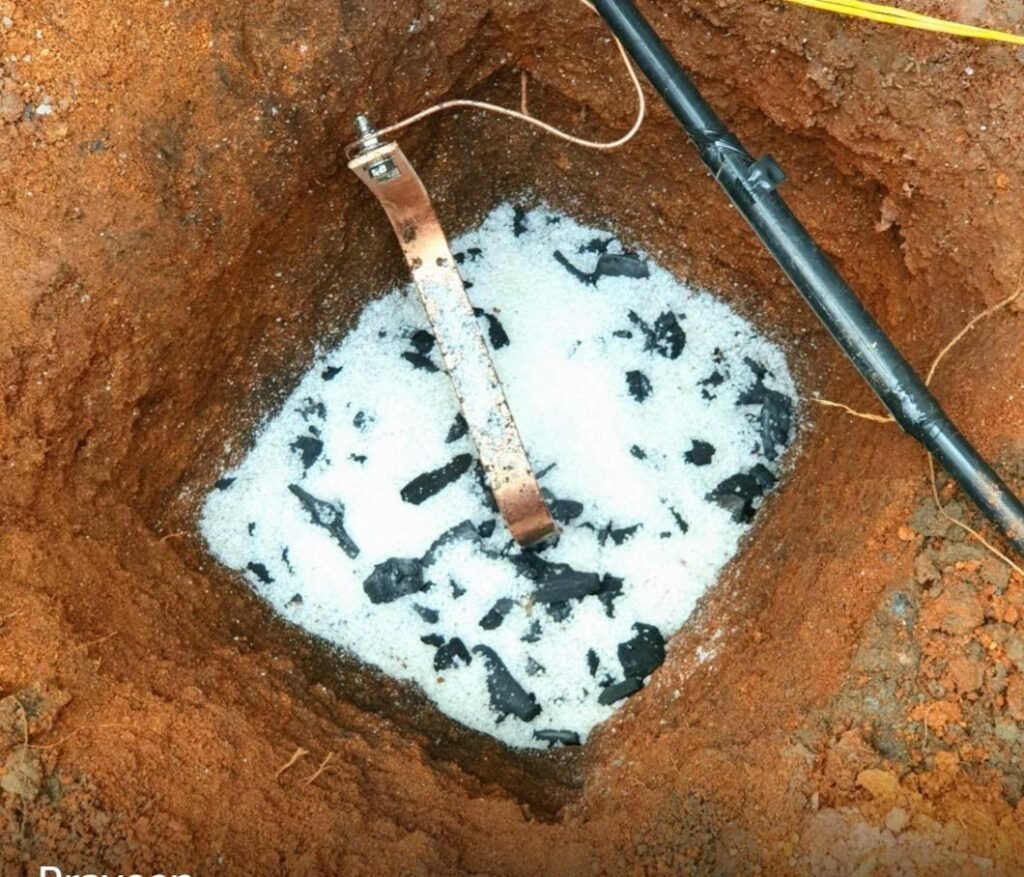
Though the ground itself being a very large body can act as an infinite sink for currents flowing into it and can be considered to be having very low resistance to current flow, the resistance of soil layers immediately adjacent to the electrode can be considerable.
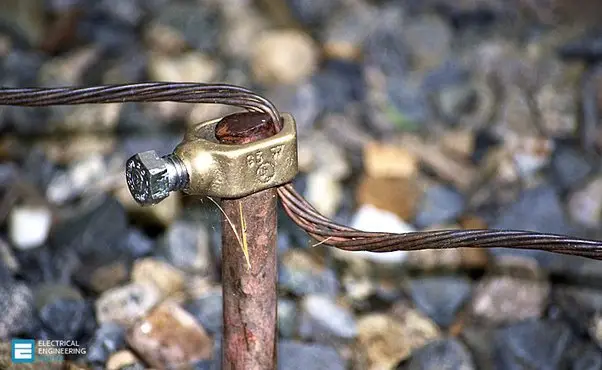
4 Things Soil Resistivity Depends On (photo credit: http://ecmweb.com)
Soil has a definite resistance determined by its resistivity that varies depending upon the type of soil, presence of moisture and conductive salts in the soil and the soil temperature.
Soil resistivity can be defined as the resistance of a cube of soil of 1 m size measured between any two opposite faces. The unit in which it is usually expressed is ohmmeter.
Resistance of the sample of soil shown in Figure 1 can be arrived at by the formula:
R = ρ · L / A
Where:
- R -is the resistance between faces P and Q Ohm
- A -Area pr faces P and Q (mz)
- L -Length of soil sample in meter
- ρ -Soil reisistivity Ohm-m
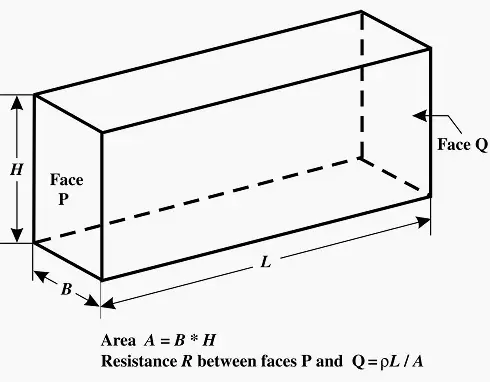
Figure 1 – Soil resistivity
Soil resistivity for a given type of soil may vary widely depending on:
- The presence of conducting salts
- Moisture content
- Temperature
- Level of compaction.
Conducting salts may be present naturally in the soil or added externally for lowering the resistivity. Chlorides, nitrates and sulfates of sodium, potassium, magnesium or calcium are generally used as soil additives.
However, the addition of such salts can be corrosive and in some cases undesirable from the environmental point of view. Especially, the presence of calcium sulfate in the soil is detrimental to concrete foundations and in case it is to be used for electrode quality enhancements, it should be limited to electrodes situated well away from such foundations. Also, over a period, they tend to leach away from the vicinity of the electrode.
Moreover, these additive salts have to first get dissolved in the moisture present in the soil in order to lower the resistivity, and provision should be made for addition of water to the soil surrounding the electrode to accelerate this process particularly in dry locations.
Home / Technical Articles / 4 Things Soil Resistivity Depends On
Soil resistivity definition //
Though the ground itself being a very large body can act as an infinite sink for currents flowing into it and can be considered to be having very low resistance to current flow, the resistance of soil layers immediately adjacent to the electrode can be considerable.
4 Things Soil Resistivity Depends On (photo credit: http://ecmweb.com)
Soil has a definite resistance determined by its resistivity that varies depending upon the type of soil, presence of moisture and conductive salts in the soil and the soil temperature.
Soil resistivity can be defined as the resistance of a cube of soil of 1 m size measured between any two opposite faces. The unit in which it is usually expressed is ohmmeter.
Resistance of the sample of soil shown in Figure 1 can be arrived at by the formula:
R = ρ · L / A
Where:
- R -is the resistance between faces P and Q Ohm
- A -Area pr faces P and Q (mz)
- L -Length of soil sample in meter
- ρ -Soil reisistivity Ohm-m
Figure 1 – Soil resistivity
Soil resistivity for a given type of soil may vary widely depending on:
- The presence of conducting salts
- Moisture content
- Temperature
- Level of compaction.
Conducting salts may be present naturally in the soil or added externally for lowering the resistivity. Chlorides, nitrates and sulfates of sodium, potassium, magnesium or calcium are generally used as soil additives.
However, the addition of such salts can be corrosive and in some cases undesirable from the environmental point of view. Especially, the presence of calcium sulfate in the soil is detrimental to concrete foundations and in case it is to be used for electrode quality enhancements, it should be limited to electrodes situated well away from such foundations. Also, over a period, they tend to leach away from the vicinity of the electrode.
Moreover, these additive salts have to first get dissolved in the moisture present in the soil in order to lower the resistivity, and provision should be made for addition of water to the soil surrounding the electrode to accelerate this process particularly in dry locations.
Moisture of soil //
Moisture is an essential requirement for good soil conductivity. Moisture content of the soil can vary with the season and it is advisable for this reason to locate the electrodes at a depth at which moisture will be present throughout the year so that soil resistivity does not vary too much during the annual weather cycle.
It is also possible that moisture evaporates during ground faults of high magnitude for long duration. The electrode design must take care of this aspect.
Effect of moisture content on soil resistivity //
Moisture Content (%)
Resistivity (in ohmmeter)
Top Soil
Sandy Loam
Red Clay
2
***
1850
***
4
***
600
***
6
1350
380
***
8
900
280
***
10
600
220
***
12
360
170
1800
14
250
140
550
16
200
120
200
18
150
100
140
20
120
90
100
22
100
80
90
24
100
70
80
Temperature of soil //
Temperature also has an effect on soil resistivity but its effect is predominant at or near 0ºC when the resistivity sharply goes up. Similarly, compaction condition of the soil affects resistivity. Loose soil is more resistive in comparison to compacted soil.
Effect of temperature on soil resistivity
Temperature (°C)
Resistivity (in ohmmeter)
-5
700
0
300
0
100
10
80
20
70
30
60
40
50
50
40
Rocky soil is highly resistive and where rock is encountered, special care is to be taken. One of the methods of increasing soil conductivity is by surrounding the electrode with bentonite clay, which has the ability to retain water and also provides a layer of high conductivity.
Unlike salts mentioned earlier, bentonite is a natural clay, which contains the mineral monmorillionite formed due to volcanic action. It is non-corrosive and does not leach away as the electrolyte is a part of the clay itself. It is also very stable.
The low resistivity of bentonite is mainly a result of an electrolytic process between water and oxides of sodium, potassium and calcium present in this material. When water is added to bentonite, it swells up to 13 times of its initial volume and adheres to any surface it is in contact with. Also, when exposed to sunlight, it seals itself off and prevents drying of lower layers.
Any such enhancement measures must be periodically repeated to keep up the grounding electrode quality. Electrodes use these principles to dramatically lower the resistance of individual electrodes under extreme soil conditions. Such electrodes are commonly known as ‘chemical electrodes’.
The IEEE 142 gives several useful tables, which enable us to determine the soil resistivity for commonly encountered soils under various conditions which can serve as a guideline for designers of grounding systems.
CREDIT: https://qr.ae/pCfCOQ